
From Risk to Resilience: Protecting health in a changing climate
What can we learn from our neighbouring countries who are already on the climate frontline?
11 March 2026 at 12:00
Online Webinar
Event Recording
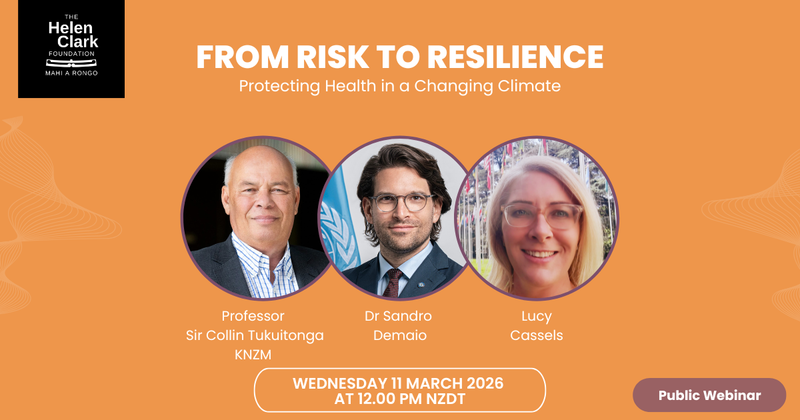
Climate change is now well-recognised as one of the most urgent threats to our health and wellbeing, and the impacts are already being felt deeply by our neighbours across the Pacific and Asia. Here at home in New Zealand, whether we look at natural disasters driven by extreme weather, or illness driven by steadily rising temperatures, climate change is reshaping the everyday conditions that keep our people healthy.
Join us for a timely and insightful webinar featuring two of our region’s leading voices in global health, who through their careers in global organisations and health research have become well-known advocates for health resilience, and how to build healthier societies in the face of climate change. Discover what WHO experts, our leading researchers and countries on the frontline of climate change impacts can teach us – and give us hope for a healthier, more resilient future.
Whether you simply want to understand what’s at stake, or work in health, policy, climate or community development, this webinar will provide a rare opportunity to hear directly from these recognised experts on an issue of concern to all of us.
Speakers:
Professor Sir Collin Tukuitonga KNZM
Co-Director Te Poutoko Ora a Kiwa | Centre for Pacific and Global Health, Waipapa Taumata Rau| University of Auckland
Professor Sir Collin Tukuitonga is one of Aotearoa and the Pacific region’s most respected public health leaders, known for his lifelong commitment to improving the health and resilience of Pacific communities. Of Niuean descent, he has held senior leadership roles across New Zealand, the Pacific, and the global health system—including serving as Director‑General of the Pacific Community (SPC), as Chief Executive of New Zealand’s then-Ministry of Pacific Island Affairs, and Director of Public Health at the New Zealand Ministry of Health. He has worked with WHO on Pacific and NCD issues over many years, including serving time at WHO Headquarters, and more recently he was appointed as Chair of the WHO Strategic and Technical Advisory Group on Prevention and Control of NCDs (STAG‑NCD) in 2024. Sir Collin is a powerful advocate for climate‑ready health systems, bringing deep regional insight and decades of experience to the urgent challenge of protecting communities in a warming world. His work sits at the intersection of climate change, health equity, Pacific wellbeing, and resilient health systems.
Dr Sandro Demaio
Director, WHO Asia-Pacific Centre for Environment and Health | WHO-ACE which serves member-states of the WHO’s Western Pacific Region
Dr Sandro Demaio took up his position as Director and Head of the WHO Asia-Pacific Centre for Environment and Health, based in Seoul, Republic of Korea, in February 2025. He brings a unique blend of academic expertise, executive leadership, and global health experience to the Centre’s mission of addressing the health impacts of environmental change across the Asia-Pacific region. Prior to this role, Dr Demaio served as Chief Executive Officer of VicHealth, the health promotion agency for the state of Victoria, Australia. He also held the position of CEO at EAT, a global non-profit organization dedicated to transforming food systems for the health of people and the planet. Originally trained as a medical doctor in Australia, Dr Demaio previously worked as a Medical Officer and technical advisor at WHO Headquarters in Geneva, where he contributed to major global initiatives on noncommunicable diseases and public health policy. With a strong commitment to advancing health through environmental sustainability and climate action, Dr Demaio leads the Centre’s efforts to drive evidence-based policy, foster multisectoral collaboration, and support countries across the Western Pacific Region.
Lucy Cassels
Honorary Senior Fellow | The Helen Clark Foundation
Lucy Cassels is a global health and environment policy commentator and researcher. A former career diplomat and senior public servant, she has held a range of roles at the New Zealand Ministry of Foreign Affairs and Trade and Ministry of Health, focused on multilateral negotiations and international development. Her career has included working across UN bases in Geneva and Nairobi, focusing on global health, environment, labour and migration, and the operations of UN specialised agencies. During the COVID-19 pandemic she spearheaded a range of health-diplomacy processes for the New Zealand Government at WHO Headquarters in Geneva. More recently, she served as Deputy Secretary at the Ministry for Pacific Peoples, as part of its Executive Leadership Team. Lucy is an Honorary Senior Fellow and researcher at the University of Melbourne, School of Population and Global Health. Here at home, she is an Honorary Fellow of the Helen Clark Foundation, where she is proud to write and speak on issues of critical interest to New Zealand and the Pacific Region, including global health and foreign policy concerns.

The Impact of Your Support
Your support makes everything we do possible - from producing new research and policy ideas, to hosting our honorary fellows programme, to running public events and member-only webinars that bring people together for meaningful conversations about New Zealand’s future.
37+
Major Reports Published
90+
Events Hosted
50+
Significant Media Appearances in 2025
12,500+
Individuals engaged with our Research