
Looking Ahead Infrastructure Symposium: Pathway to 2060
Read Rt Hon Helen Clark's speech from the recent infrastructure symposium in Auckland, organised by the New Zealand Infrastructure Commission

Helen Clark Foundation
22 April 2026
On Tuesday 21st April, more than 150 infrastructure leaders attended in-person at the New Zealand International Convention Centre in Auckland for the annual infrastructure symposium hosted by Te Waihanga | The New Zealand Infrastructure Commission. Called "Pathway to 2060", the symposium featured a range of speakers who talked about how New Zealand can address the infrastructure challenges we are facing, and how we can build on the work in the National Infrastructure Plan.
The Foundation's patron, Rt Hon Helen Clark, spoke at the event. Her speech is presented below.
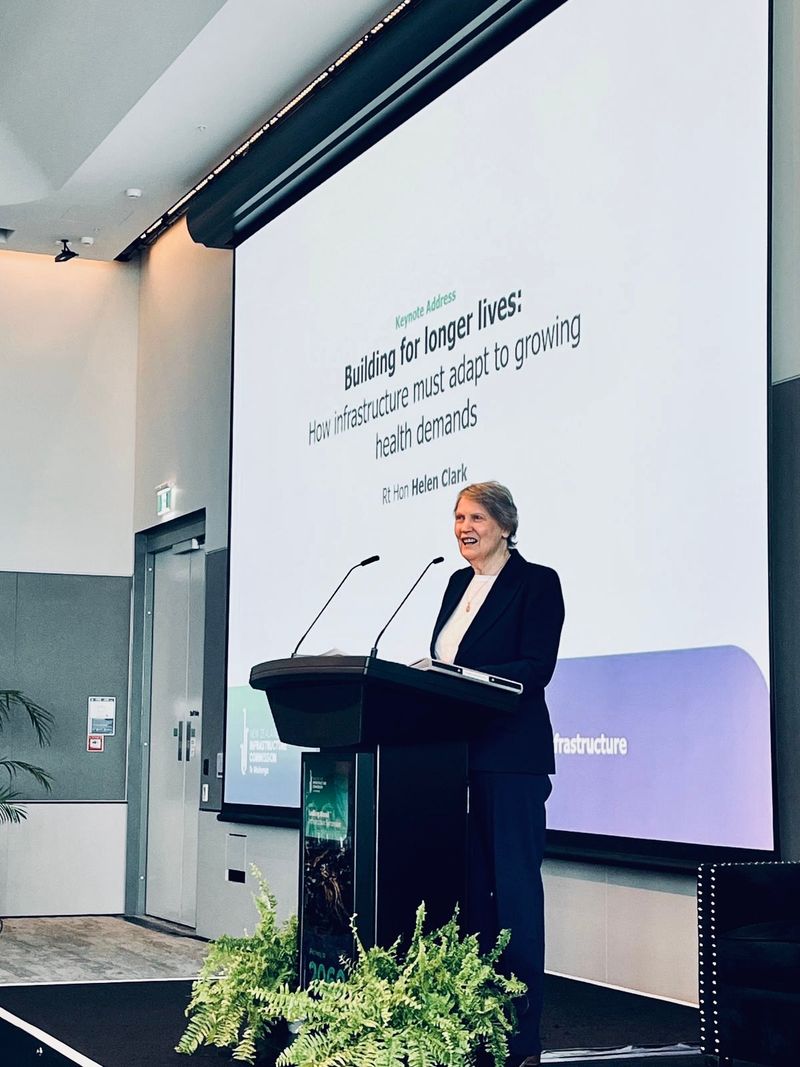
Speech at “Looking Ahead: Infrastructure Symposium 2026”.
Auckland, 21 April 2026.
Greetings and many thanks for the invitation to speak today.
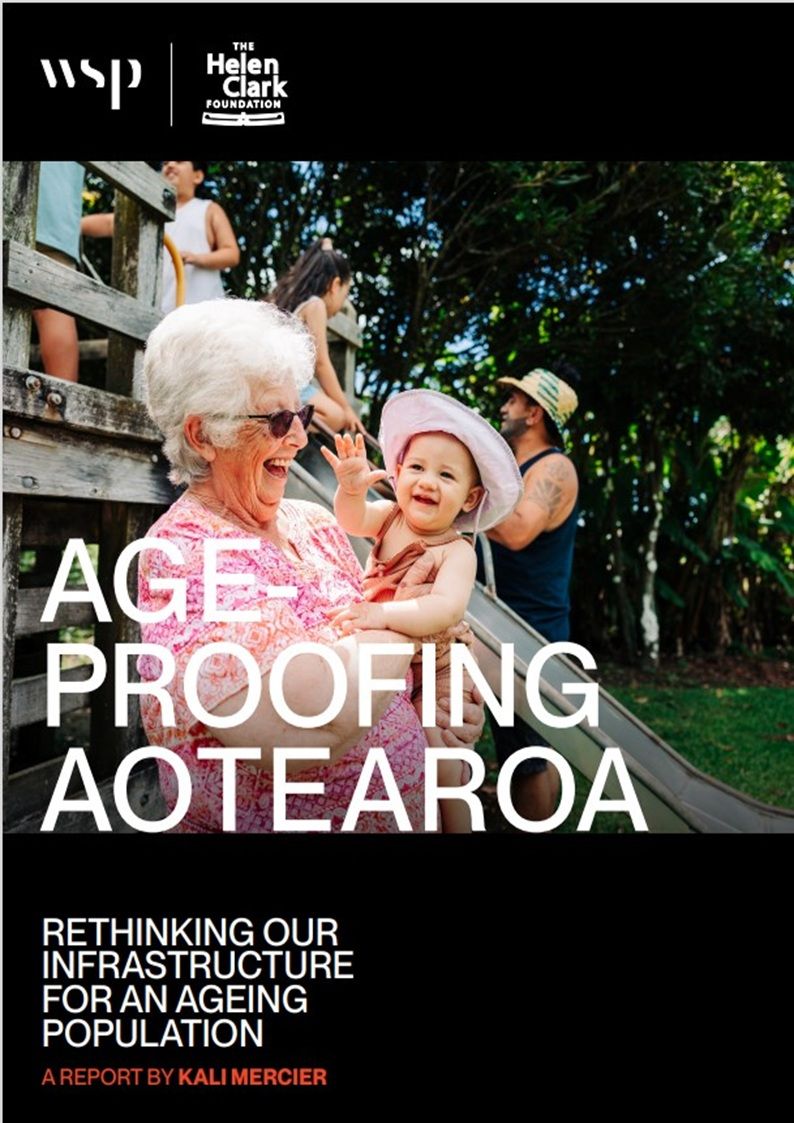
I’ve been asked to talk about “Building for longer lives: How infrastructure must adapt to growing health demands”. This topic relates to a recent Helen Clark Foundation by Kali Mercier – “Age-Proofing Aotearoa”, which looks in depth at the infrastructure implications of our changing demographics. I’ll be drawing on Kali’s research in my speech today.
By 2051, just 26 years away, projections suggest there will be nearly twice as many people aged over 65 in New Zealand as there are today — that’s potentially 700,000 more older New Zealanders than there are now. By 2060, there may be as many as three to four times as many people over the age of 85 as there are today.
The implications are clear – there will be significantly more demand for health and elder care facilities, housing which meets the needs of the frail elderly, social services support, and accessible transport.
Our increasing life expectancy is a positive story – we are living longer, healthier lives. Many older people continue in paid work, and/or volunteer, care for grandchildren and great grandchildren, and otherwise contribute to their communities.
People aged 65 and over report the highest life satisfaction of any age group in New Zealand. That is something to celebrate. But we do need to plan for the needs which inevitably arise from an ageing population, and that involves considering a range of infrastructure and policy choices.
The scale of what is coming
We are experiencing what demographers call structural ageing. Our population is shifting from a pyramid shape — lots of young people at the base supporting fewer older people at the top — to something more like an obelisk, where the lines at the top grow longer while the base narrows. We share this trend with most OECD countries.
The shift to structural ageing is uneven across our country. Areas like Tasman, Nelson, and Marlborough are already what demographers call hyper-aged — more than twenty per cent of their residents are 65 or older. By 2048, more than 30 per cent of people in those regions will be in that age bracket.
While Auckland, Wellington, and Christchurch are ageing more slowly, each faces a significant growth in older people in absolute numbers over the next two decades. Auckland can expect to have around 200,000 more seniors by 2048.
There is a fiscal reality behind those numbers. As the Infrastructure Commission has noted, in 1960, New Zealand had seven working-age people for every person over 65. Today, that ratio is roughly four to one. By the 2070s, it will be two to one on current projections. Thus, the age group which is the largest recipient of government support — through superannuation, and health and other care services — is the fastest growing. The working-age population which funds those services will begin to shrink from the early 2030s.
Treasury projects that superannuation alone will grow from 5.1 per cent of GDP today to around 8 per cent by 2065. Health expenditure is projected to rise from 7.1 per cent of GDP to around 10 per cent in the same period.
We are heading, in other words, toward a period of steeply rising costs, and a shrinking base of people to pay for them. Unfortunately, the New Zealand Superannuation Fund, which was designed to cushion the impact of the demographic bulge of older people, has not had the continuity of support which would have enabled it to perform to its full potential.
So, we need to be smart about where we invest, and acknowledge that what may look like soft investments can actually moderate the need for more hard infrastructure investment.
On the care continuum
When we think about the investments needed for an ageing population, the tendency is to think of more hospital and residential care beds. Yet, ageing in place at home is a good option, provided the necessary support services are available, and it is decidedly more cost effective than institutional options.
The average cost per client for home care support services paid by Health New Zealand was $20 per person per day in 2022. Subsidised aged residential care cost Health NZ roughly $180 per person per day. A hospital bed may cost as much as $1,000 per day.
Investing in home and community support services — personal care, cleaning, cooking, home maintenance, and simple things like changing a light bulb or mowing a lawn — helps people to age at home and lessens demand for investment in aged care infrastructure.
Of course, investment is needed across the spectrum of services. New Zealand has a projected shortfall of as many as 12,000 aged care beds by 2032. Waiting times for high-priority placements depend on where you live.
The average wait time for an aged care placement is nearly three months in the Mid-Central area, but more than seven months on the West Coast. Individual wait times are often far longer than this.
Some older people — disproportionately Māori, Pacific, and those without financial means — often cannot access such care at all.
So-called “bed blocking” - where an older person cannot be discharged from hospital because there is no aged care bed available for them - is already common in New Zealand. It is both unpleasant for the person concerned, and expensive for the state.
This is a system which is already under strain. An ageing population will push it to breaking point unless we act — and act now, in the right places, in the right order. We need more aged care beds, distributed more equitably across the country.
But the right place to invest first is in home care – which is consistently underfunded. Home care workers are among New Zealand's lowest paid. In general, they use their own vehicles between jobs and are not well reimbursed for that.
The sector has lost eight per cent of its workforce in just two years. A government review found that current funding levels are significantly too low for providers to deliver adequate care.
A systems approach would see us investing more in the most cost-effective options – like home care.
Health infrastructure: planning for a future we can see coming
New Zealanders aged over 65 already use more than 42 per cent of total health services, despite making up just 17 per cent of the population. By 2051, projections suggest that 63 percent of all public health services will be used by those over 65.
Per-person health spending for someone aged 85 and over is sixteen times higher, on average, than for a 40-year-old.
Yet hospital investment in this country has slowed to near-historic lows over the past decade. We have a hospital in Queenstown that was built in 1988 for 4,500 people. It now serves nearly 80,000. There is no clear plan for what replaces it. This is not an isolated example.
Health New Zealand last year published its first national health infrastructure plan. The Infrastructure Commission’s draft National Infrastructure Plan sets out projections for the investment needed to renew ageing hospitals and expand services for both a growing and an ageing population. These are welcome steps.
But the first iteration of the Health Infrastructure Plan is short on population modelling and regional detail. There is not yet a clear picture, region by region, of what health infrastructure will be needed, where, by when, and how it will be funded.
Given that it can take a decade or more to plan, fund, design, consent, and build a hospital, this is not a problem we can leave for later. The time to do this planning is now.
Again – system wide thinking is needed. Digital health and telehealth can expand access to care, reduce waiting times for getting attention, and bring services closer to people in rural communities.
New models of care — more distributed health hubs, stronger primary and community care, better integration between GPs and specialists — can reduce pressure on hospitals. Preventive care and public health investment can keep people healthier for longer.
There is no version of the future in which we can avoid the need to increase hospital capacity significantly. But smart investment in prevention, technology, and new care models will moderate how much we need to build — and enable us to get the best value for money.
Housing and accessibility
New Zealand’s housing shortage is particularly acute in the kinds of housing older people need: smaller, accessible, well-located homes with good access to services and public transport.
Home ownership among the over-65s is falling. By 2040, only around half of New Zealanders over 65 are projected to own their own home. More older people will be renting — largely in the private market.
Older renters now are twice as likely as homeowners to live in poorly maintained housing and to experience conditions such as anxiety, depression, and respiratory illness.
This is a health issue with public infrastructure implications. Older people who live in substandard or unsuitable housing are more likely to have accidents, more likely to end up in aged care earlier than necessary, and more likely to present to hospital. The connection between the quality of housing and health is not indirect — it is direct, well evidenced, and expensive to ignore.
Accessible housing deserves particular attention. People aged 65 and over are much more likely to be disabled than younger adults. As the population ages, the need for accessible housing will grow significantly.
Yet most of New Zealand's housing stock is not built to universal design standards. A home modification which costs a few thousand dollars to incorporate at the design stage can cost twenty times as much to retrofit later, according to the New Zealand Disability Support Network’s calculation.
Kāinga Ora now aims for fifteen percent of new public housing builds to meet full universal design standards, but there have been calls for that to rise to 85 per cent or more, to catch up on the backlog and to prepare for a different future. We need equivalent requirements — through incentives or mandates — for the private sector, which builds the vast majority of new homes in this country.
Getting housing right for older people is not charity. It is responsible system design.
Age-friendly cities and the urban dividend
Our streets, our neighbourhoods, and our cities are also infrastructure – which can either support healthy ageing, or work against it.
New Zealand is among the most car-dependent nations in the world. When older New Zealanders can no longer drive, they risk losing access to services and to social connection and the activities that make life meaningful. Social isolation is not only a personal misfortune. It is a public health risk, associated with depression, cognitive decline, heart disease, and earlier death.
Age-friendly city design addresses this directly. It includes creating walkable neighbourhoods, accessible public transport, safe pedestrian crossings, green spaces, seating along walking routes, and mixed-use zoning that puts services within reach without a car. These things benefit everyone, but they are essential for older people.
People in walkable neighbourhoods are reported to average fifteen per cent more physical activity, with direct reductions in chronic disease. Age-friendly design reduces falls, which are the leading cause of injury among older New Zealanders. Social infrastructure — parks, libraries, community centres — reduces loneliness and builds connection.
Thirty-five New Zealand cities are now engaged with the Age-Friendly Aotearoa programme. That is encouraging, but researchers are finding a gap between commitment and implementation which needs to be closed.
Japan, which is facing a steeper demographic shift than New Zealand, has moved increasingly toward compact city models. They work hard to concentrate housing, healthcare, retail, and public transport in accessible central areas, enabling older people to live independently for longer.
The investment framework we need
All of this costs money. But failing to plan and invest costs more.
Two reports by the Helen Clark Foundation set out how to improve infrastructure investment.
The first, Built to Last, looks at lifecycle asset management — the discipline of caring for the infrastructure we already have, which we consistently underinvest in maintaining and renewing. A more strategic approach to asset management would extend the life of existing infrastructure. It would dramatically reduce the cost of crisis replacements, and give us a far clearer picture of what actually needs to be built new.
A second report, due to be released next month, looks at how we measure value when we make decisions about how to invest in new infrastructure. It seems that our system is inconsistent, often driven by political rather than evidence-based logic, and lacking the rigorous cost-benefit framework needed to allocate scarce public capital wisely.
This report will suggest that New Zealand use cost-benefit analysis not only for individual projects, but also to prioritise investment within portfolios. We could be using it to think about how to save money across whole systems — health, housing, aged care, transport, and urban design — in an integrated way.
Cost-benefit analysis, done well, and applied across whole portfolios and across government spending more widely, would allow us to compare a dollar spent on home care with a dollar spent on an aged care bed with a dollar spent on a hospital. This kind of analysis makes explicit the choices we are considering. That allows us to find the investments that save money downstream — such as the home modification which prevents a fall, the community transport service which allows a person to access services and thus live at home longer, and the aged care bed that releases pressure on a hospital ward.
As a small, flexible country with a fairly centralised governing system, we can, and should, be able to pivot to take such a systems approach.
What change would be helpful now?
We would benefit from having a national population plan which projects demographic change at the national, regional, and local levels, and requires infrastructure planning at each of those levels to respond to it. Both the Infrastructure Commission and the former Productivity Commission have called for this.
There needs to be more cross-government co-ordination on ageing, with the aim of producing a long-term, evidence-based strategy and aligning investment across health, housing, aged care, transport, and urban design. Right now, different agencies are largely left to plan in silos, with no incentive to make investments that save money in another agency's budget.
The funding gaps in aged care must be addressed through transparent pricing, adequate subsidies, and targeted capital assistance for facilities in rural and underserved areas. Australia Aged Care Capital Assistance Programme could provide insights here.
We need to invest seriously in home and community support services — not as a soft social spend, but as probably the most cost-effective health intervention available to us.
We need more accessible housing built to universal design standards, in the right locations, with the right transport links. Central and local government both have roles to play, and the private sector needs the right incentives.
We need those age-friendly cities as a planning requirement, backed by funding and genuine accountability. The Planning Bill that is currently under consideration would be a good place to lock down the requirement of local authorities to take into account population demographics when they do their spatial plans.
Conclusion
The infrastructure decisions made in the next decade will shape our lives - the hospital which does or doesn’t exist, the aged care bed that is or isn’t available, the accessible or inaccessible home, the bus which does or doesn’t come when you can no longer drive.
These are not abstract policy questions. They are personal ones.
The good news is that we can see what’s ahead for our society. We have the data. We have projections. We have, in broad terms, knowledge of what works. What we need is the courage to plan for the long term, to make investments which pay off over decades rather than electoral cycles, and to treat the infrastructure needs of an ageing population as the systems challenge it is — not a series of separate crises to be managed one at a time.
With foresight, co-ordination, and the willingness to invest upstream rather than wait for the crisis downstream, New Zealand could be one of the best places in the world in which to grow old. That is the aspiration. The question is whether we have the ambition to match it with action.
Thank you.
Keywords

The Impact of Your Support
Your support makes everything we do possible - from producing new research and policy ideas, to hosting our honorary fellows programme, to running public events and member-only webinars that bring people together for meaningful conversations about New Zealand’s future.
37+
Major Reports Published
90+
Events Hosted
50+
Significant Media Appearances in 2025
12,500+
Individuals engaged with our Research