
New report calls for stronger use of cost–benefit analysis in infrastructure investment
A new research report from engineering firm WSP and the Helen Clark Foundation is calling for a more consistent, disciplined, evidence-led approach to infrastructure investment across Aotearoa New Zealand.

Helen Clark Foundation
21 May 2026
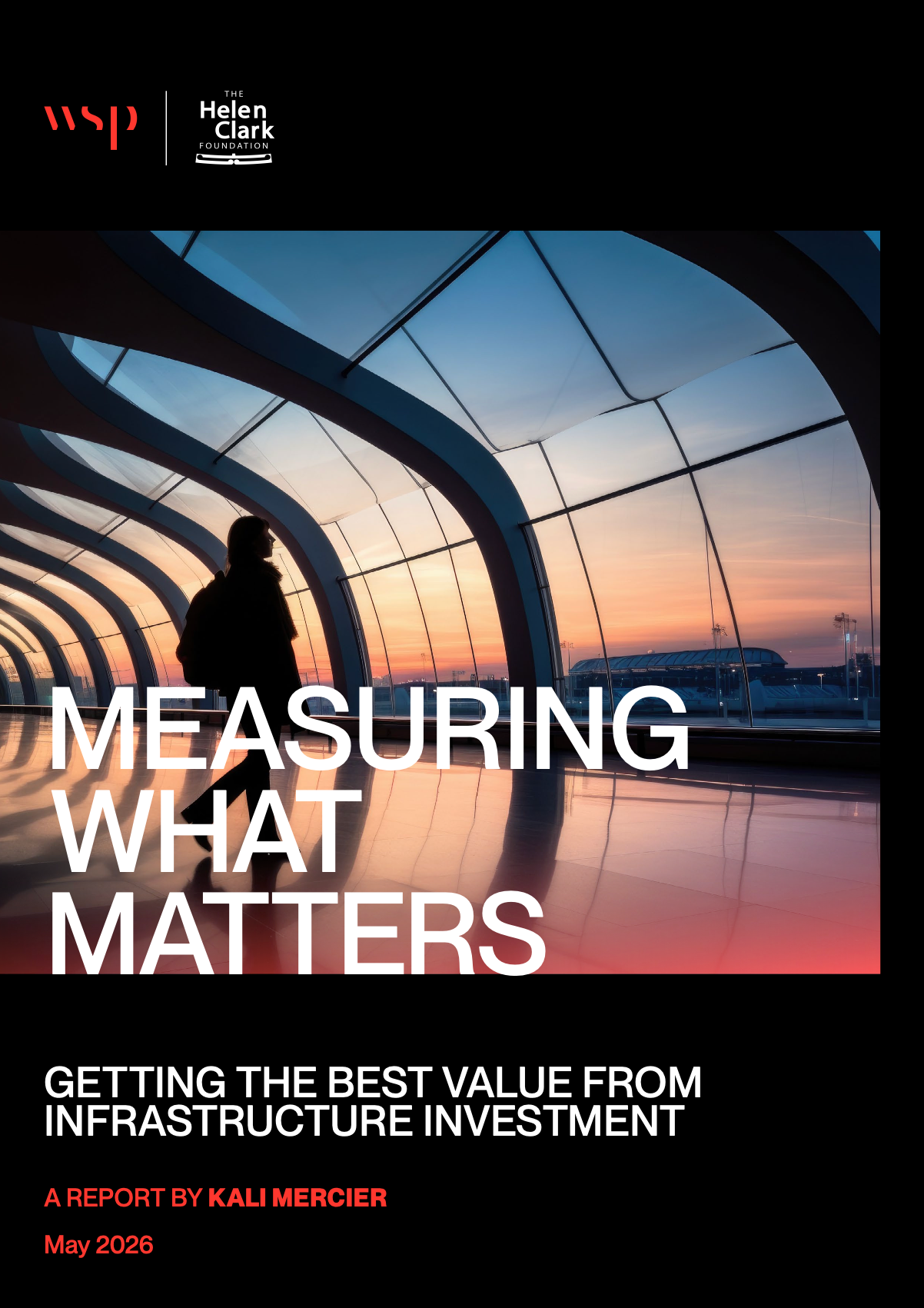
A new research report from engineering firm WSP and the Helen Clark Foundation is calling for a more consistent, disciplined, evidence‑led approach to infrastructure investment across Aotearoa New Zealand.
The report, Measuring what Matters – getting the best value from infrastructure investment, finds that despite billions of dollars being spent on infrastructure each year, New Zealand lacks a mandatory, system-wide requirement for demonstrating value for money across infrastructure investment decisions.
It highlights that cost–benefit analysis (CBA), the primary tool for assessing the social, environmental, and economic impacts of investment options, is used inconsistently across much of central and local government.
Report author and WSP Fellow at the Helen Clark Foundation Kali Mercier says the findings show a clear opportunity to strengthen decision‑making at a time when fiscal pressures are intensifying.
“Infrastructure decisions shape the country for generations. They influence how our cities function, how resilient we are to climate change, and how well public services meet people’s needs. Yet of the six infrastructure-intensive central government agencies we contacted, only NZTA and Kāinga Ora consistently use cost-benefit analysis to inform infrastructure investment decisions.
“In a tight fiscal environment, every dollar spent from the public purse should deliver the greatest value to New Zealanders. CBA is one of the most effective tools available for testing trade-offs and value for money, enabling comparison of investments - yet, central government agencies are not using it consistently, or in some cases, at all. That means we are not responding as effectively as we could to some of the key infrastructure challenges we’re facing, such as our ageing population or adapting to climate change.”
The report draws on Infrastructure Commission data showing that fewer than a quarter of Budget infrastructure bids over the past five years included a cost–benefit analysis. Kali says this means major funding decisions are often made without a clear steer about their value for money, and their strategic priority.
“New Zealand has strong frameworks for CBA, but because its use isn't mandatory, whether and how it applies varies significantly. This makes it harder to compare options, harder to prioritise what to build and when, and harder to ensure long‑term value for money.”
WSP Technical Director – Economic Advisory Quanita Ali says CBA is most effective when it's applied early in the planning process and supported by high‑quality data. It helps decision‑makers understand trade‑offs, test assumptions behind projects, and compare very different types of investments using a consistent evidence-based framework.
“At a time when governments and councils face increasing debt and affordability pressures, it can also help focus investment on projects that deliver the greatest long-term value.
“With more consistent use, CBA can support a more strategic, long-term approach to infrastructure planning, one that aligns investment with the outcomes New Zealanders value.”
The report notes that the country faces significant and compounding pressures, including an ageing population, climate change, fiscal constraint, and an estimated $193 billion in unfunded infrastructure in the national pipeline. Despite this, there is currently no mandatory process to require investments to be compared within or across sectors using a consistent evidence base.
It also highlights that New Zealand rarely evaluates whether completed infrastructure projects delivered what they promised, limiting the country’s ability to learn from past decisions.
Kali says this gap is a missed opportunity.
“We don’t routinely check whether projects achieved the outcomes they were funded to deliver. Without post‑implementation evaluation, we can’t ensure public money has been used effectively, and we also miss opportunities to improve future decisions. This, combined with the lack of transparency within the system, makes it extremely difficult to hold decision makers accountable.”
The opportunity for improvement is significant, she says.
“We have the tools and frameworks to build a much stronger investment system. Using cost–benefit analysis more consistently would help ensure decisions are transparent, evidence‑based, and aligned with the long‑term wellbeing of New Zealanders.”
Key report recommendations include:
- Mandatory use of CBA for all major central government infrastructure investments, supported by enhanced training, clear guidance, and sector‑specific tools.
- An independent infrastructure assurance framework, with the Infrastructure Commission playing a strengthened independent assurance role, and requiring publication of business cases and cost-benefit analysis.
- Routine post‑implementation evaluation of major projects to assess whether expected benefits were achieved.
- More strategic, cross‑portfolio use of CBA, supporting more consistent comparison of similar investments across sectors such as health, housing, justice, and transport.
- Closer alignment between the Budget process and long‑term investment planning, including exploring multi‑year capital budgeting.
Keywords

The Impact of Your Support
Your support makes everything we do possible - from producing new research and policy ideas, to hosting our honorary fellows programme, to running public events and member-only webinars that bring people together for meaningful conversations about New Zealand’s future.
37+
Major Reports Published
90+
Events Hosted
50+
Significant Media Appearances in 2025
12,500+
Individuals engaged with our Research