
Social Cohesion in New Zealand 2026
Are we coming together, or drifting apart?

How strong is our social fabric?
Social cohesion is the foundation on which New Zealand navigates complexity and challenges. Our second annual Social Cohesion Survey finds that cohesion in New Zealand has slipped across every dimension measured — but there is also reason for hope.
What does the report say?
84% feel they belong
More than 8 in 10 New Zealanders feel a sense of belonging to the country, and take pride in the New Zealand way of life. But only half feel a strong sense of community in their local area.
Trust is at a record low
Only 2 out of 5 New Zealanders trust the government to do the right thing. Trust in the courts has fallen from 57% to 45% in a single year, the biggest drop in the survey.
Young people feel isolated
Nearly 2 in 3 under-30s say they feel isolated at least sometimes. Nationally, the share who feel isolated often has risen from 1% in 2010 to 14% in 2025.
Safety is not equal
Only 45% of women feel safe walking alone at night, compared to 69% of men.
1 in 4 go without meals
About a quarter of New Zealanders sometimes go without meals because they cannot afford food. Among under-30s, the figure is even higher at 40%.
We are getting less hopeful
The share of New Zealanders who see the country as a land of opportunity fell from 51% in 2024 to 45% in 2025. We are becoming less hopeful, not catching up.
The Three New Zealands
Which group do you feel part of?
Using two years of survey data we've identified three distinct groups who experience New Zealand very differently. Hover or select a circle below to learn about each group.
Hover or select a circle to learn about each group.
Think you know New Zealand?
Some of the findings might challenge assumptions.
Who feels the strongest sense of belonging?
Young Māori. Among under-30 Māori, 87% report a sense of belonging. Among under-30 Asian New Zealanders, it is 73%.
Which voters feel the most isolated?
Green Party voters. 61% of Green voters report feeling isolated, compared to 39% of National voters. This likely reflects differences in age profile and financial circumstance.
Who says immigration is too high?
Not who you might expect. Pasifika respondents (44%) are more likely than NZ Europeans (38%) to say immigration is too high. Asian respondents are the least likely (22%). And financial stress predicts attitudes to immigration more than ethnicity does.
Who supports a strong leader who bypasses Parliament?
Mostly the young. 38% of under-30s support this idea, compared to 17% of over-65s.
Who thinks social media is bad for society?
Most of us. But most of us still use it every day. 58% use it several times a day. 55% of us say it is bad for society.
Who has the biggest gap between hope and reality?
Young New Zealanders. They are the most aspirational age group, but report the lowest lived experience of social cohesion.
Who feels safest walking alone at night?
Men (69%) compared to women (45%). A 24 percentage point gap that has not changed.
Lessons from the United Kingdom
This year, we also analysed the UK policy community's social cohesion action space, looking at what the UK has pursued to improve its social cohesion.
The United Kingdom shares a colonial history with Aotearoa, has long experience of immigration and ethnic diversity, and has articulated strong ambitions to improve social cohesion. We used this common interest as the basis for reflecting on the UK's community's action space related to social cohesion as it affects their community groups and government organisations. You can read more in the supplementary report linked below.
What can be done?
Social cohesion is slipping, but small actions can bring us closer together.
Friendship across cultures builds belonging
People with close friends from a different ethnic or religious background consistently report a stronger sense of belonging. The good news is that 83% of New Zealanders already have at least one. The connections are already there in our workplaces, schools, and neighbourhoods. We just need to strengthen what already exists.
Belonging keeps people connected, even under financial pressure
New Zealanders who are struggling financially but still feel a strong sense of belonging stay involved in their communities at similar rates to those who are comfortable. Belonging does not fix poverty, but it changes what poverty does to people's connection to the world around them.
Young people are a resource
Young New Zealanders experience the worst outcomes on almost every measure in this survey — but they are also the most hopeful age group. They have not given up on the idea that things can improve. That matters, and it is something we should make the most of.
Diverse media diets matter
People who get their news from a wide range of sources, traditional and social, report the best social cohesion outcomes. Media literacy and diverse consumption habits are protective.
Home ownership anchors belonging
Homeowners show 7.4 percentage points higher civic participation and 14 points higher neighbourhood belonging than renters. With about half of adults now renting, housing policy is cohesion policy.
Financial stress is the dominant driver
No amount of community programming can compensate for economic policy that leaves people behind. Financial stress predicts low belonging, low trust, high isolation, and negative attitudes to immigration more than almost any other variable.
About the report
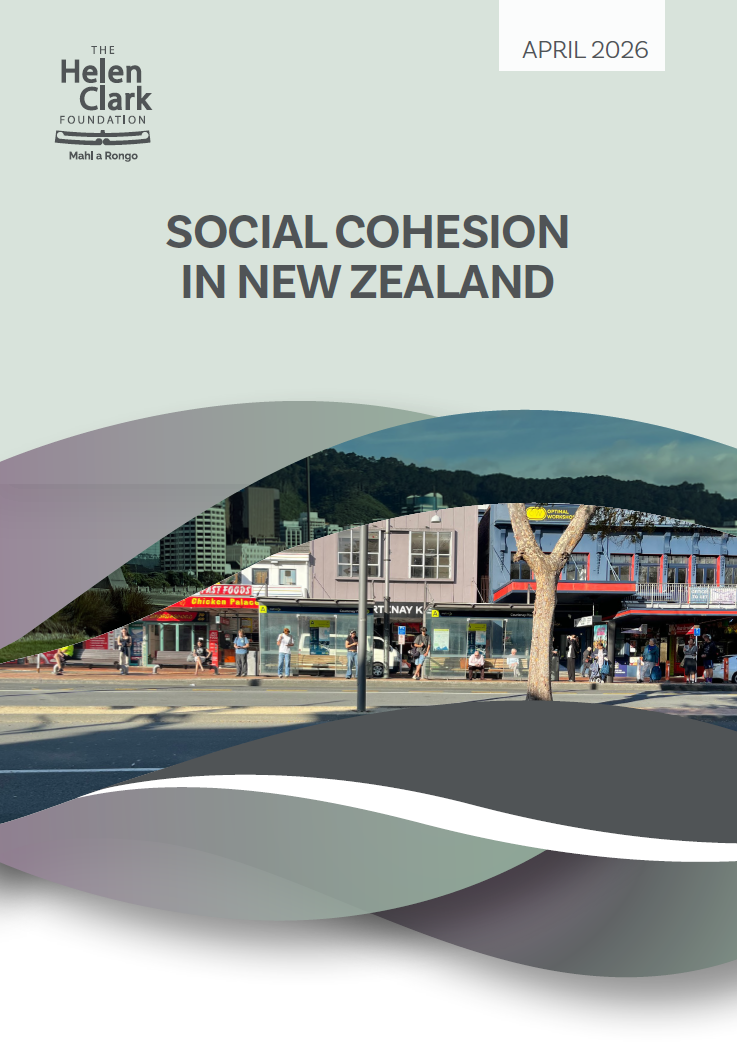
Social Cohesion in New Zealand 2026 is the second annual report from the Helen Clark Foundation measuring social cohesion across the country. The survey is modelled on Australia's Scanlon Foundation Social Cohesion Monitor, allowing comparison across the two countries.
The 2025 wave surveyed 2,882 New Zealand adults in November and December 2025, with booster samples for Māori, Pacific, and Asian communities to ensure representative breakdowns. All estimates are population-weighted.
Funders and acknowledgements
This project is made possible through funding by The Simplicity Foundation, The Tindall Foundation, The Todd Foundation, Internet NZ, NetSafe, and The Wayne Francis Charitable Trust. This funds the survey work.
The research, analysis, production, and hosting of this work is provided on a pro bono basis by The Helen Clark Foundation and Shamubeel Eaqub. Research by Shamubeel Eaqub, Rosie Collins, Charlotte Knights, Isaac Baxter, and Taylor Marston.




Enter your details to download:

The Impact of Your Support
Your support makes everything we do possible - from producing new research and policy ideas, to hosting our honorary fellows programme, to running public events and member-only webinars that bring people together for meaningful conversations about New Zealand’s future.
37+
Major Reports Published
90+
Events Hosted
50+
Significant Media Appearances in 2025
12,500+
Individuals engaged with our Research