
AI is already in every classroom, policy needs to catch up
New Zealand schools urgently need guidance on the safe and beneficial use of AI in schools

Sarah Bell
20 October 2026
With a rapid rise in the use of AI in our education system, Helen Clark Foundation Senior Researcher Sarah Bell argues that New Zealand schools urgently need guidance to support the safe and beneficial use of AI in schools. This piece was originally published in the New Zealand Herald.
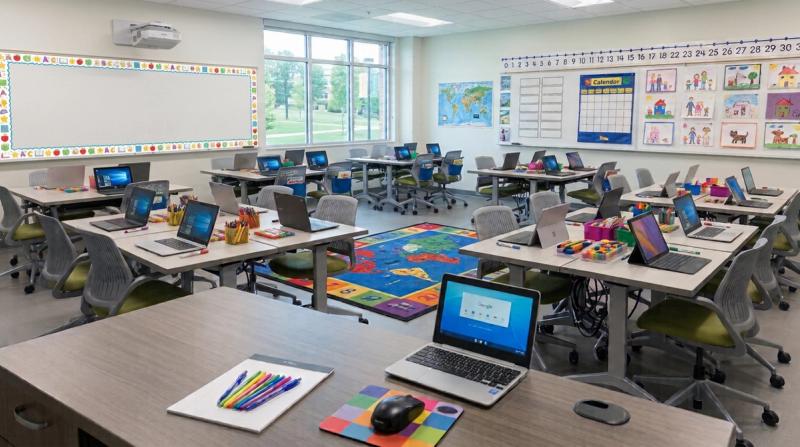
Imagine your day as a school principal in New Zealand. Teachers report that students are handing in AI-generated essays. Parents have heard teachers are using AI for marking and want to know if that’s allowed. A department head wants to use a new AI tutoring tool, and you don’t know how to find out how it uses student data.
You look online for guidance, but it’s incomplete and scattered across different agencies. What you really want is a comprehensive national policy, but you’re told that our devolved school governance model makes that impossible. As one leader in AI governance for schools put it to us: “AI uptake is going nuts, governance is going nowhere, and risk is skyrocketing”.
The evidence bears that out. More than nine in ten school leaders, four in five teachers, and three in four students in New Zealand are now using artificial intelligence at school, according to a recent report by the Education Review Office that reveals what is actually happening in our classrooms*.
We need to keep pace with the technology now sitting in nearly every classroom in the country. The Helen Clark Foundation, supported by Hiraya Ventures, is currently examining how New Zealand’s education system should respond to the growing power and accessibility of AI. As we approach this year’s election, every political party should be thinking about this too.
Right now, schools are being left to work things out on their own, and the results are concerning. Around seven in ten school leaders told ERO their school has no active policy covering the privacy and security of teachers' own use of AI. Where a school has any policies for how students should use AI, fewer than half of teachers and students say they are useful. And two in five secondary students admit to using AI in ways they know they shouldn’t for their schoolwork.
Teachers, students and school leaders say they are using AI because it helps: teachers are turning to it to ease administrative load, plan lessons and tailor material to individual students' needs; students are using it mainly to find information, generate ideas and get feedback on drafts. Used well, AI can free up teacher time for the parts of the job that matter most - direct instruction and relationships with students. It can also help develop forms of individualised support for learners with additional needs in ways that were previously out of reach for all but the best-resourced schools. What schools are asking for, consistently, is clearer national guidance, more professional development to allow teachers to feel confident using AI, and stronger AI literacy education for students so they can use it safely and effectively to support learning.
The risks are just as real as the opportunities. Poor implementation can expose students' personal data to platforms with few safeguards. Research shows that AI can let students skip the productive struggle and critical thinking required for real learning, with negative impacts on educational outcomes. Education experts are concerned that poorly-controlled AI use can also mask gaps in student learning and deprive teachers of the opportunity to correct those gaps. Poorly-controlled AI use may also create dependency on AI that means students do not have the real-world skills they need to flourish. And without deliberate policy attention, AI risks widening the gap between students whose schools and families can help them use these tools well and those who cannot.
Governments and school districts overseas are already acting. Estonia invested in teacher training, then gave senior secondary students access to a purpose-built tool designed to guide student thinking - rather than hand over answers. Singapore begins teaching early primary students about how AI works and how to use it safely, before gradually exposing them to AI use from Year 4 onwards. By early 2025, roughly half of US states had published some form of AI guidance for primary and secondary schools. Many of these initiatives form part of a strategy or framework, combining legislation, curriculum updates, teacher training and procurement rules in pursuit of an agreed vision or goal.
Any lessons New Zealand draws from overseas need to be adapted to our local context, not imported wholesale. We have our own school governance structure, and our own obligations under Te Tiriti o Waitangi — including how AI tools handle Māori data, an issue Māori data sovereignty experts have been raising as this technology moves into classrooms. But it is clear that many schools do not have the capacity or expertise to navigate these issues alone.
Our research and conversations with educators and experts across the sector strongly underline what recent reports have found: central government needs to do much more, and soon, to support the safe and beneficial use of AI in schools. With a general election now just weeks away, voters should be asking how our political parties plan to address this challenge. This shouldn't be a partisan issue. Every New Zealander has a stake in children learning well, in teachers being supported and in student data being protected.
Our research and recommendations will be published early next year, giving the next government an evidence-based foundation for responding to this crucial policy priority in a way that must endure beyond election cycles. But it’s already clear that we need a more coherent approach at the national level, and before November 7, every party should tell parents and teachers what it will do.
*The ERO survey referenced here covered English-medium schools only.
Keywords

The Impact of Your Support
Your support makes everything we do possible - from producing new research and policy ideas, to hosting our honorary fellows programme, to running public events and member-only webinars that bring people together for meaningful conversations about New Zealand’s future.
37+
Major Reports Published
90+
Events Hosted
50+
Significant Media Appearances in 2025
12,500+
Individuals engaged with our Research